
REMEMBER ME — THE GAME THAT NEVER GOT THE CHANCE IT DESERVED
A Gamesnippets Feature Story
There’s something quietly fascinating about a game that refuses to shout for your attention. Remember Me is one of those titles. It doesn’t introduce itself with fireworks or some overconfident promise that it’s the next big thing. It’s more subtle than that, the kind of experience that waits to be discovered, not pushed. And maybe that’s both its greatest strength and the reason so many players missed it the first time around.
When you revisit Remember Me today, more than a decade after its release, the most surprising part isn’t that the game still looks good or that its world still holds up, it’s realizing how much it tried to say, how much it wanted to explore, and how bold its ideas were long before they were fashionable in mainstream gaming. This is a game that, in hindsight, feels ahead of its moment. It’s almost strange how such an ambitious concept managed to not just slip between the cracks, but fall through them entirely.
Yet that’s precisely why returning to it feels so rewarding. It’s one of those games that quietly waits for people who enjoy discovering something that feels almost… forgotten but meaningful. And once you enter Neo-Paris, it becomes clear that this is not just another dystopian setting. It’s a crafted, intentional world built with a confidence that suggests the developers weren’t trying to impress anyone, they were trying to express something.
A FUTURE DESIGNED TO FEEL UNCOMFORTABLY FAMILIAR
Neo-Paris 2084 is a city stitched together by memory or more accurately, by the loss of it. The people walking down the clean corporate streets have memories that aren’t entirely their own. Some have given away painful ones to feel lighter; others have purchased artificial ones to feel more whole. Most don’t question it. Most don’t want to.
That’s the unsettling beauty of Neo-Paris: it mirrors us. Not in an exaggerated, sci-fi way, but in the way all believable futures do, by taking something from today and pushing it just far enough to make us uncomfortable. The city isn’t chaotic or apocalyptic. It’s organized. Attractive. Efficient. Sterile in the way only overly controlled societies can be.
And this is the world Remember Me brings you into without ceremony, as if expecting you to simply observe and absorb instead of needing explanations. The game trusts you to understand the unease beneath the surface. It’s a quiet sort of confidence rarely seen in games from its era.
NILIN: A PROTAGONIST BUILT ON WHAT’S MISSING
Nilin, the game’s protagonist, stands out not because she’s portrayed as powerful, but because she’s introduced as broken. She begins her story with her memory fractured, a literal blankness where her identity should be. Instead of being the kind of hero who rushes into action fully aware of who she is and why she matters, she starts at a disadvantage, piecing herself together step by step.
What’s interesting about Nilin is that the game doesn’t treat her memory loss as a gimmick or a device meant only to justify mystery. It treats it like a weight she has to carry the entire way through. She remembers fragments - a voice, a feeling, a failure but never enough to feel grounded. And that instability shapes everything she does.
You don’t follow Nilin because she’s the strongest in the room. You follow her because she’s navigating a story she’s barely connected to, yet somehow central to. She’s trying to reclaim ownership of her mind in a city where memory itself is currency. It gives the entire plot a personal anchor without forcing emotional moments on you. They just happen, naturally, as she rediscovers herself.
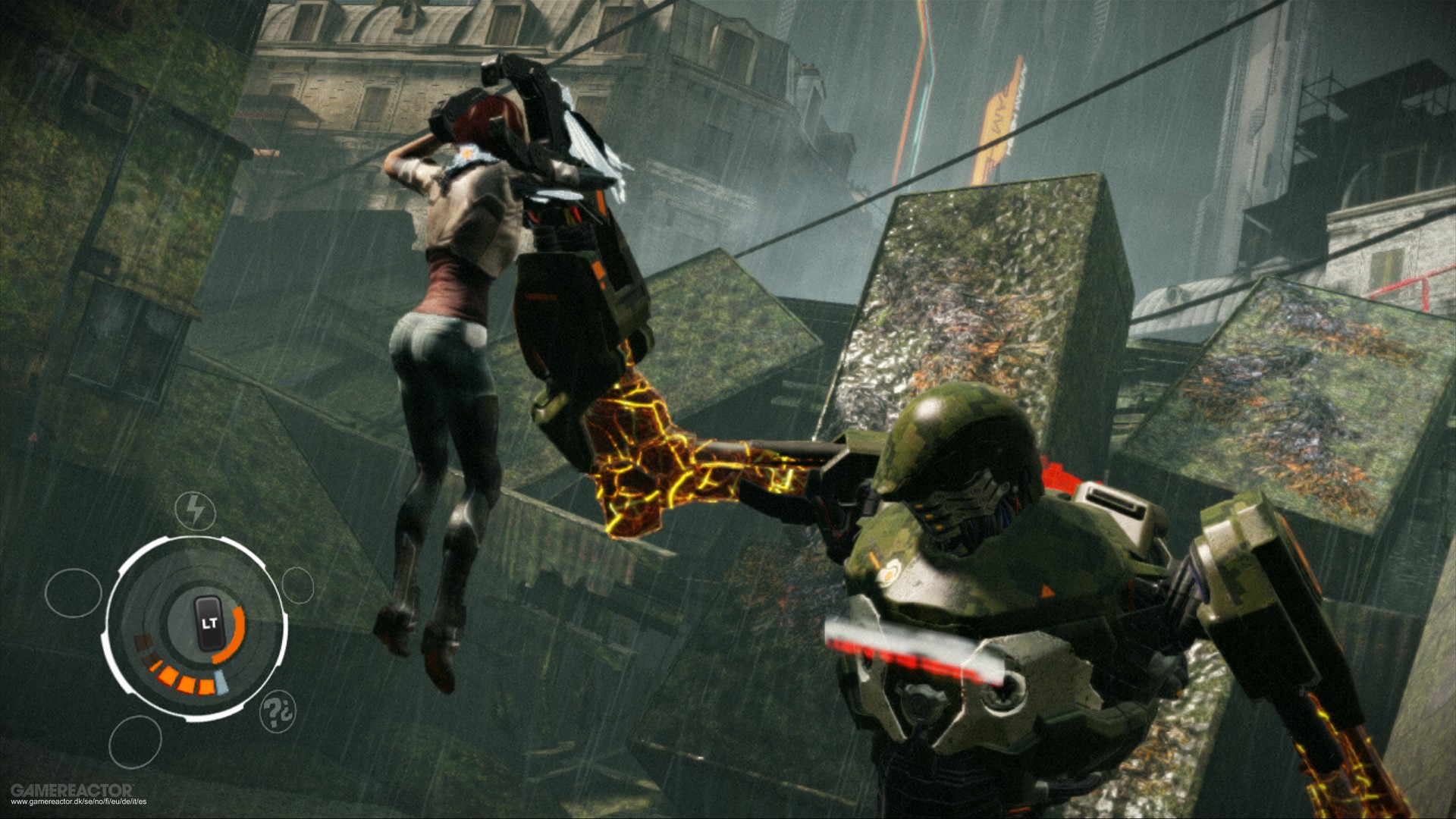
Nilin isn’t written to be overly cinematic. She’s not designed around “hero moments” or melodrama. She’s reflective, observant, steady, a character built more on internal conflict than spectacle. That’s part of what makes her stand out so clearly even today.
THE MEMORY REMIX: STILL ONE OF GAMING’S COOLEST IDEAS
If there’s one thing Remember Me is still remembered for, even by players who didn’t finish it, it’s the Memory Remix mechanic. And honestly, it deserves every bit of that recognition.
There’s something almost hypnotic about entering someone’s memory and rearranging the pieces until the meaning changes. It’s such a strange combination of puzzle-solving, storytelling, and psychological play that even now, no other game has attempted to imitate it.
You’re not just interacting with a cutscene; you’re altering cause and effect inside someone’s mind. You rewind memories, tweak small details, a cup knocked over, a gun safety switched off, a seatbelt unbuckled and watch the consequences ripple through the moment. It's cinematic without being scripted, organic without being random.
The fact that the game uses these sequences sparingly makes them even more powerful. They feel deliberate. Purposeful. Not added for flair, but for storytelling. And the moral discomfort they provoke isn’t accidental. You’re rewriting people’s emotional truths, after all. The game doesn’t let you forget that.
It’s the kind of bold game mechanic that could’ve easily become the foundation of an entire franchise. Instead, it remains a one-of-a-kind idea, unique to Remember Me alone.
THE GAMEPLAY: MORE ABOUT FEELING THAN FLUENCY
Let’s be honest: this is where Remember Me received the most criticism. Some players wanted more freedom in combat. Others wanted deeper mechanics or smoother movement. But replaying it years later, it becomes clear that the combat system, especially the customizable combo system wasn’t trying to mimic other games. It was trying to make you think about your approach instead of button-mashing through encounters.
Some games define themselves with polished mechanics. Remember Me defines itself with experience. The way it feels to move through its environments, the way its art direction frames the world, the way its soundtrack pushes the mood, all of it comes together not to create technical perfection, but emotional coherence.
What stands out more now is how the game’s pacing serves the narrative. The quieter segments aren’t filler. They’re reflection points. The action bursts aren’t chaotic. They’re stress peaks. The rhythm of gameplay feels more story-driven than systems-driven.
If you're coming into Remember Me expecting a combat-first, mechanics-heavy spectacle, you’re missing the heart of its design. This is a game where the mechanics exist to carry the story not the other way around.
NEO-PARIS AS A CHARACTER
Many games build worlds; fewer games build cities that feel alive without demanding attention. Neo-Paris belongs to the latter group. It isn’t a world you explore freely, but it’s one that always feels present, watching, influencing.
You notice it in the small details:
the holographic ads you can almost touch…
the layered architecture mixing decay and futurism…
the civilians who behave like their memories are fragile possessions…
the constant presence of technology that bridges convenience and control.
The city speaks not through exposition but through design. It tells you that everything is too polished, too efficient, too curated. And that something so perfectly managed must be hiding a cost.
Even today, Neo-Paris feels distinct from other sci-fi cities. It’s not cold like Deus Ex’s cyberpunk worlds. It’s not gritty like the slums of other dystopian games. It’s elegant, almost beautiful and that beauty makes its moral rot more striking.
WHY REMEMBER ME STILL MATTERS
In a gaming landscape filled with sequels, remasters, battle passes, and algorithm-driven design, Remember Me feels refreshing precisely because it wasn’t built for mass appeal. It didn’t chase trends or try to position itself as the next big franchise. It was a creative risk, one that didn’t fully pay off commercially but left behind a world worth revisiting.
The game matters today because:
-
It explored identity at a time when most games were focused on power fantasies.
-
It built a world that feels more believable now than it did in 2013.
-
It introduced a bold mechanic that remains unmatched.
-
It centered its narrative on emotional experience instead of spectacle.
-
It carries the kind of artistic confidence rarely seen in mid-budget titles now.
Most importantly, it offers something that modern gaming often forgets: a self-contained, thoughtful story that doesn’t need endless updates or external content to feel complete.
WHO WILL LOVE THIS GAME TODAY?
If you enjoy games that prioritize atmosphere…
If you like stories that reveal themselves slowly rather than loudly…
If you appreciate worlds that feel intentionally built…
If you enjoy science fiction rooted in human emotion…
If you want to experience a game that did something different…
Then Remember Me will feel like a rare find, a hidden chapter of gaming that was waiting for you.
Fans of titles like Control, Mirror’s Edge, Detroit: Become Human, and Hellblade will feel at home here. Not because the mechanics match, but because the emotional tone does. The introspection. The world-building. The subtlety.
THE VERDICT: A GAME WORTH REMEMBERING
Remember Me may not have become a blockbuster or a franchise, but that’s part of what makes it special. It remains one of those games that says exactly what it wants to say, offers precisely the experience it intends to offer, and leaves you with something to think about long after the credits roll.
It’s a game that rewards players who appreciate intention.
A game that wasn’t designed for everyone and didn’t need to be.
A story about memory that, ironically, stays with you.
And in a time where so many games chase attention, Remember Me earns something rarer:
a place in the minds of players who value meaning over noise.
That alone makes it worth playing or replaying today.